Revisiting Modi's role in the 2002 mass slaughter of Gujarat Muslims
Prime Minister Narendra Modi, a lifelong member of the Hindu extremist group RSS, asked police to allow Hindus to vent their anger to Muslims, leading to deaths and destruction unprecedented in post-independence India.
Just In
In 2002, anti-Muslim carnage engulfed the Indian state of Gujarat, killing at least 1,000 people. Most of the victims were Muslims. The chief minister of Gujarat was Narendra Modi, a lifelong member of the Hindu extremist RSS. He ordered police not to stop the massacres.
What led to the 2002 Gujarat massacres?
On Feb 27, 2002, Sabarmati Express, a train carrying Hindu kar sevaks (pilgrims) returning from the site of the demolished Babri Masjid, was attacked. 59 people lost their lives in a fire that broke out in one of the train cars just outside the station of Godhra.
The cause of the fire is still the subject of contention. In 2008, the Gujarat government-appointed Nanavati-Mehta Commission concluded that local Muslims had set the train on fire. The Justice Bannerjee Committee, established by the Indian government's railway minister in 2005, reached the opposite conclusion, concluding that the fire was accidental.
The death of 59 Hindu passengers was instantly exploited by Hindu extremist groups like the Rashtriya Swayamsevak Sangh (RSS), Vishwa Hindu Parishad (VHP), and Bajrang Dal to incite Hindu hysteria, incite the genocidal massacres, and claim they were in self-defence against Muslim terrorism. Hindu mobs, unrestrained by state police and encouraged by then chief minister Modi, launched a state-wide campaign of retaliation against Muslims.
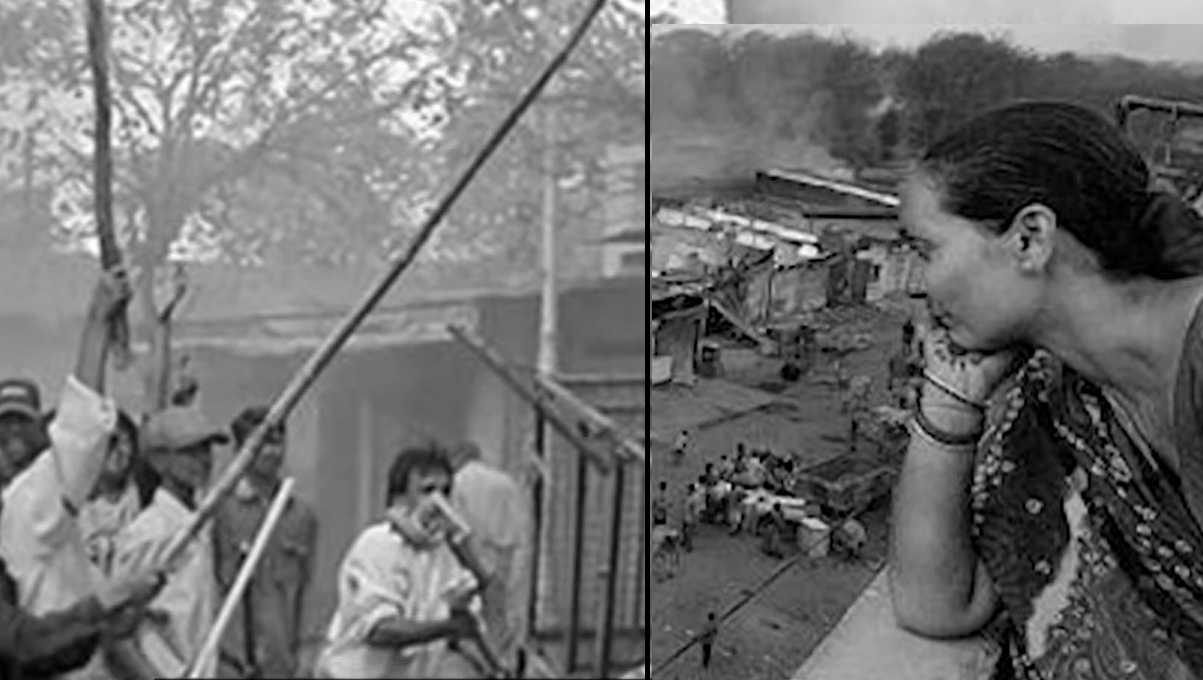
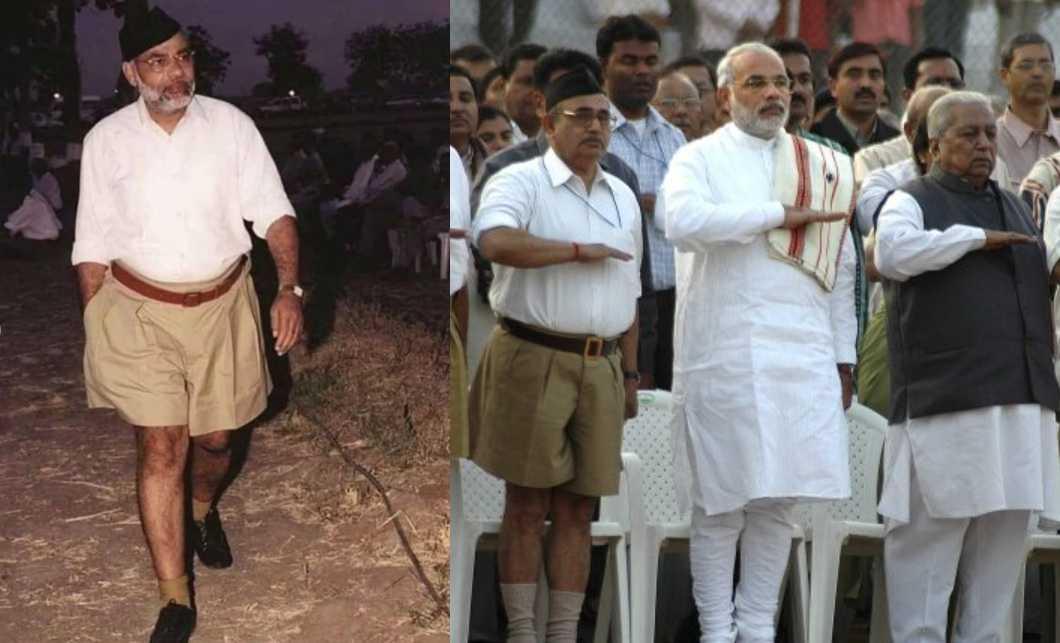
By the afternoon of Feb 27, retaliatory attacks had already begun. Donning the Rashtriya Swayamsevak Sangh (RSS) uniform of khaki shorts and a saffron headband, the mobs carried out attacks in a highly coordinated manner.
Armed with a list of Muslim homes and businesses, they arrived in Muslim neighbourhoods by truckloads carrying swords, metal pipes, and LPG cylinders. The rampaging mob stormed into the housing complex of Ehsan Jafri, a former highly regarded Muslim member of the Indian parliament. The mob murdered Ehsan Jafri and 68 other Muslims who had sought refuge in his house.
Jafri had desperately tried to contact the police commissioner and the office of chief minister Modi but never got through.
Investigative journalist Ashish Khetan secretly taped conversations with the three Vishwa Hindu Parishad (VHP) activists Mangilal Jain, Prahaladji Asori, and Madanlal Raval, who described the events surrounding Eshan Jafri's murder. They confirmed to Khetan that Jafri had made desperate phone calls to police officers and political leaders.
According to the three men, the police not only gave them unfettered freedom but also encouraged the rioters to kill Muslims. They claimed that the rioters were given three to four hours to carry out the killings by the police inspector in charge of Meghaninagar police station, KG Erda. These secretly taped conversations, however, were ignored by the Supreme Court of India's Special Investigation Team.
During the massacres, at least 250 women and girls were gang-raped before being burned to death. A mob of 5,000 people set fire to houses of Muslims in Ahmedabad's Naroda Patia neighbourhood, resulting in the death of at least 65 people. Before being burned and hacked to death, women and girls were gang-raped in public. Their male family members were forced to watch the rapes and then were killed.
Hina Kausar from Naroda Patiya was pregnant when she was raped. Several eyewitnesses testified that she was raped and tortured and that her womb was slit open with a sword to extract the foetus, which was then hacked to pieces and burned alive alongside the mother.
Bilkis Yakoob Rasool was five months pregnant when she was gang-raped. 14 members of her family, including her three-year-old daughter, were murdered in front of her eyes.
The Gujarat government has now granted early release to all 11 of her convicted rapists.
A mass grave was discovered in Ahmedabad in January 2004 by a group of medical professionals and forensic specialists. 46 of the 96 bodies were of females. Most of the bodies showed evidence of torture, mutilation, and burning. The female bodies had burns from cigarettes on their bottoms and breasts. Sharp objects had been inserted inside their damaged, cut-open genitalia.
The young women and girls who were raped and killed, as well as the male family members who were made to witness it, suffered irreparable mental harm. Parents were forced to watch their children being murdered.
Children who survived, the vast majority of whom were orphaned, have been severely harmed and traumatised by the violence. They witnessed the rape, mutilation, murder, and burning of family members.
Surviving family members had to fend for themselves in recovering and identifying their loved ones' bodies, which added to their trauma.
Gujarat state police stood by and refused to assist Muslims fleeing from Hindu mobs. Muslim NGOs were left with the responsibility to provide relief and rehabilitation.
The Muslim community of Gujarat experienced the carefully planned destruction of their homes, businesses, and property.
Hundreds of Muslim girls and women were raped, mutilated, and burned to death in Gujarat. Many of the women interviewed in relief camps were victims of sexual violence, including rape, gang rape, and insertion of objects into their bodies.
International law in cases in the ICTR and other courts recognise that the use of sexualised violence in genocide is a method of preventing births by causing serious physical and mental harm to the women and by knowingly degrading and stigmatising them, rendering women either unable or ineligible to participate voluntarily in the reproductive life of the community.
The state's complicity and intent
Many attacks on Muslims took place within view of police posts and police stations. However, the first police and troops did not arrive where mobs struck before March 1, three days after the massacres began.
The mobs carried the voter lists and lists of all Muslim-owned businesses. According to an Outlook magazine report, attempts to pinpoint the exact location of Muslim businesses began months before the attacks. Politicians at the local and state levels were spotted directing the violent mobs, controlling the police, and organising the distribution of weapons.
Gujarat's then-home minister, Haren Pandya, claimed Modi convened a meeting on Feb , 2002, in the aftermath of the Godhra train fire. According to Pandya, Modi instructed the police officers not to interfere with "the Hindu backlash". Pandya was later assassinated and therefore unable to testify before commissions of inquiry.
Similar allegations were made in an affidavit filed in the Supreme Court of India by ex-India Police Service officer Sanjiv Bhatt. According to Bhatt, during his meeting on Feb 27, 2002, Modi asked police officials to allow Hindus to "vent out their anger" against Muslims.
This article is adapted and edited from a report prepared by Genocide Watch in August 2023, an organisation that seeks justice for victims and survivors of genocides and aims to deter future genocides.
See more of our coverage in your search results.
Subscribe to our newsletter
To be updated with all the latest news and analyses daily.