Reflections on 'Fractures Beneath The Crown'
A soul-searching tour of Rahmi Bujang's exhibition on power and the place of the people.
Photographs by MalaysiaNow
Visitors enter the O Sculpture Art Space in George Town, Penang, where Rahmi Bujang's work is on display as part of an exhibition titled 'Tanah Airku: Retak Dibawah Mahkota' or 'Fractures Beneath The Crown'.

The venue is near Jalan Datuk Keramat, at the site of the Hin bus depot in Jalan Gurdwara, under the shadow of the iconic Komtar building.

Na'imah Khalid, the widow of former finance minister Daim Zainuddin, to whom the exhibition is dedicated, speaks to visitors before launching the exhibition.

Rahmi Bujang (centre) presents Na'imah Khalid with a ceramic vase after the exhibition launch.

Rahmi Bujang explains the concept of the exhibits to Na'imah Khalid. His works, intended as a critique of ruling politicians, are inspired by Daim Zainuddin and dedicated to him.

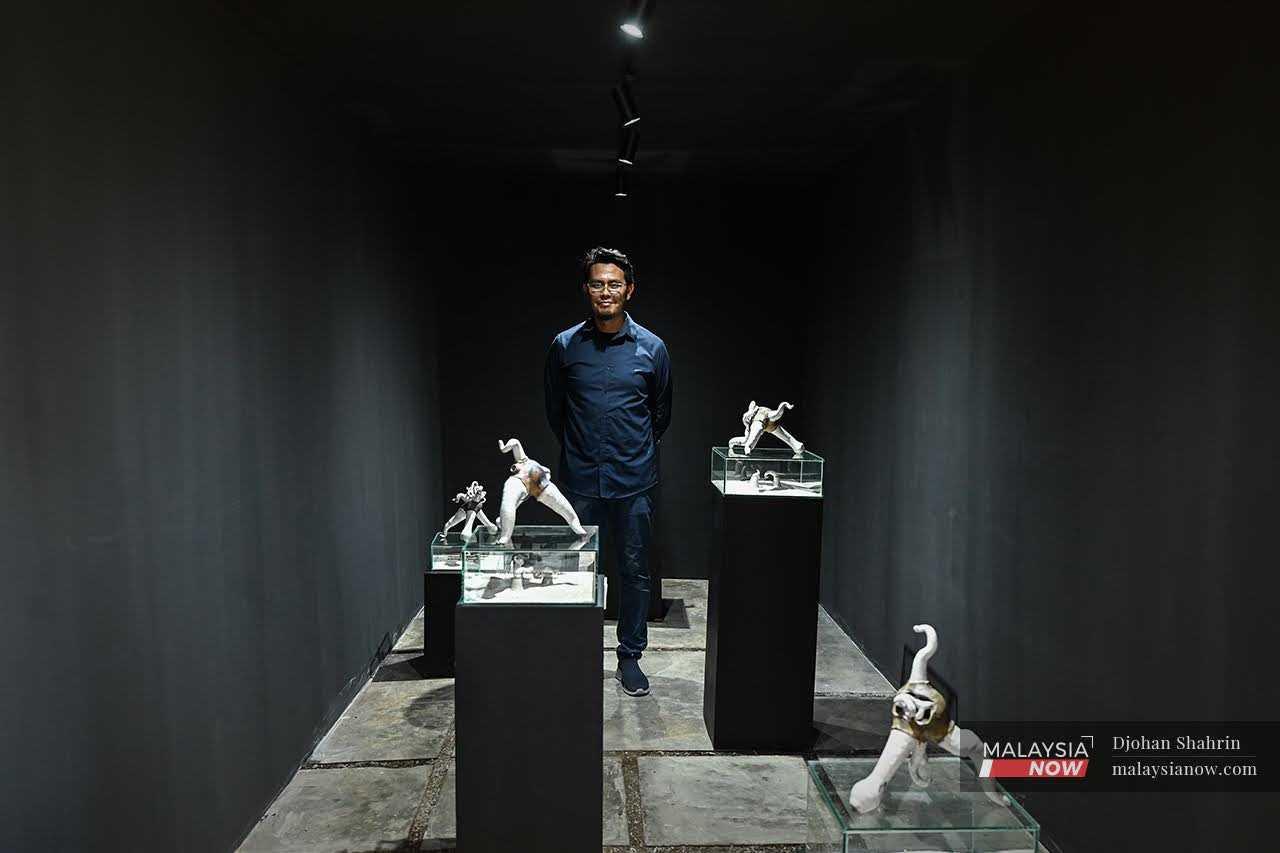
Ceramic sculptures meant to depict ceremonial idols to power.

For Rahmi Bujang, the sculptures, which were born from his love for his homeland, are an expression of the fractures in the country which are covered up with a facade to conceal the decay.
A visitor reflects on the message that Rahmi Bujang seeks to convey through his work.

Part of Rahmi Bujang's 'The Left Hand of Power', intended to present a critical reflection on power, politics and institutional greed.

'Scattered Traces', which presents the narrative of a homeland, the path of which is winding and branching, symbolising the people seeking space to live within the cycles of history and power.

The words inscribed in each sculpture are meant as messages from the people to those in power.

'Upon the Throne of Pretense Series 2' presents a tiered structure imitating latrines, symbolising the stratified decay of power.

'Tongue, Horns & Shadows of Power Series 4', a six-piece work which serves as a metaphor for the face of politics – graceful on the outside yet fragile within.

'We are not Subjects', through which Rahmi Bujang questions the meaning of leadership and institutions.

The central motif is revolution through form, texture and meaning.

The sculptures also signify the irregularities of struggle born from a 'root love' for one's homeland.

Rahmi Bujang sees sculpture as a medium that unveils the true face of politics, satirises greed for power, and gives form to the anxieties of a people caught in the paradoxes of leadership.

He uses his art to create spaces for reflection on the fragility of national unity and the need to return to universal human values.

The cracked glaze symbolises fractures in a system that appears strong but is crumbling from the inside.

Each work is a commentary on the reduction of a people to the level of servants in their own land.

See more of our coverage in your search results.
Subscribe to our newsletter
To be updated with all the latest news and analyses daily.